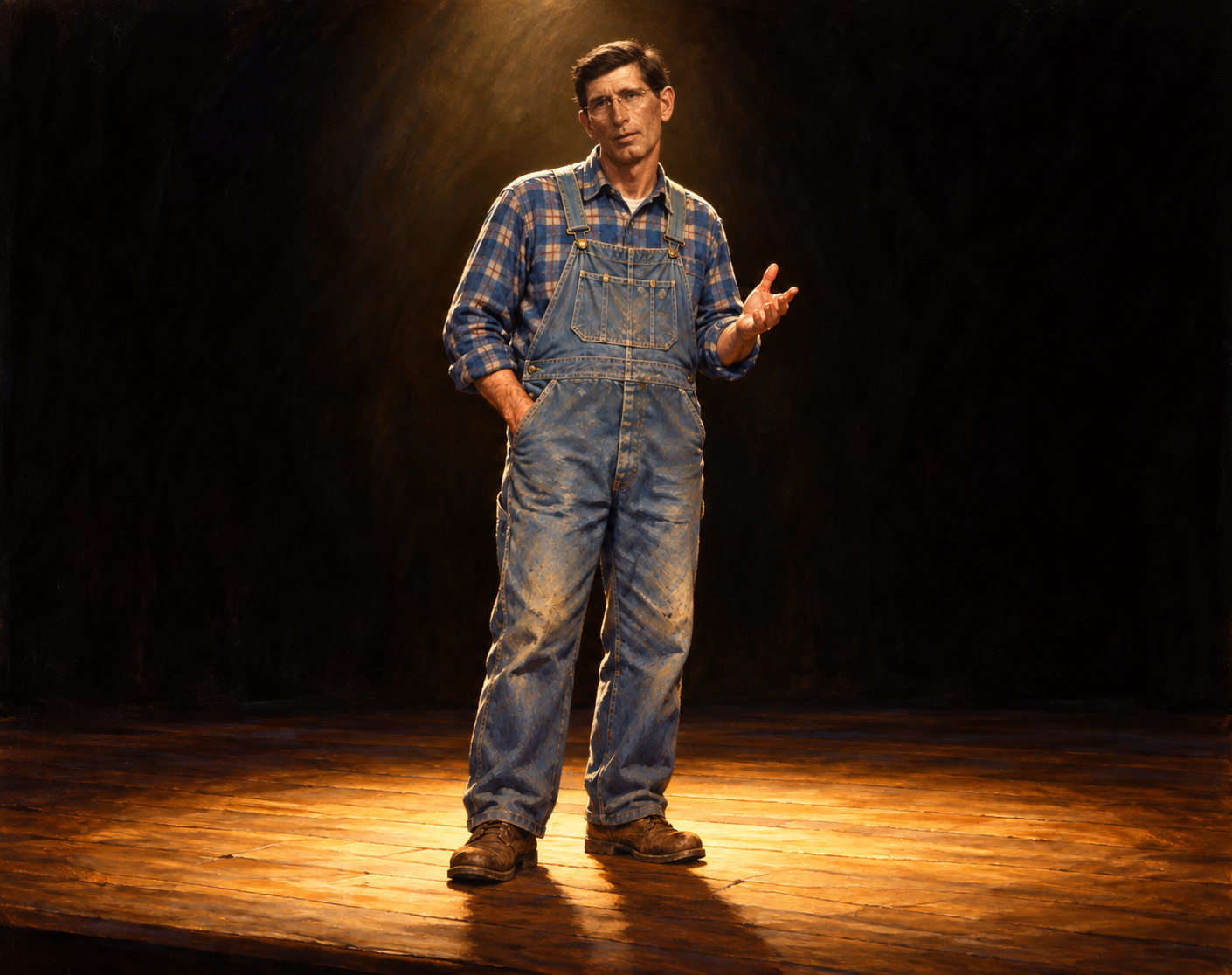
Scene 1: A darkened stage. The intensity of a single spotlight rises to reveal a man standing at center stage dressed in a blue flannel shirt and worn overalls. He is of average height with dark black hair, direct-looking blue eyes, a broad forehead, and strong work-hardened hands.
He speaks:
My name is John C. Smith. The C stands for Clarence. My parents and brothers called me Johnny; everyone else called me John or Mr. Smith. I was the oldest of five children; born in 1894 - the same year as Nikita Khrushchev and Jack Benny. I farmed all my life; finished formal schooling after the eighth grade. My hero when I was young was a man by the name of Dan Carroll, the single teacher in a one-room schoolhouse. He took a special interest in me. I won a scholarship to attend high school in Pittsfield IL but instead it went to a person with “connections” as they say. Our farm was 7 miles from Pittsfield so I would have had to live with some family in town to attend high school. My family needed me on the farm anyway.
A great personal event in my life was being drafted in the First World War at the age of 24. I spent one year in the army but never got further than Fort Zackary Taylor, Kentucky. I contracted and survived the worldwide pandemic of influenza in the winter of 1918-19 that killed several hundred men at Camp Zackary Taylor. I was discharged in May of 1919 and returned home in time to help get the crops planted that spring.
~~~~~~~~~~~~~~~~~~~~~~~~~~~~~
Scene 2: The light follows John as he strides to a table to his left and stands across from where Margaret is seated, slicing apples into a bowl on her lap. She is wearing a print dress under a dark blue apron. She wears no makeup over her Irish complexion; an oval-shaped face with high cheekbones and a high forehead. Her auburn hair, which is turning grey, is wrapped into a bun on her head. The light finds and envelops Margaret as she turns around and smiles. She speaks:
My maiden name was Margaret Mary Raftery. I was born in 1902 and orphaned two days later. The doctor who infected my mother Minnie supplemented his practice by also practicing veterinary medicine. The speculation was that he carried some kind of infectious disease on his hands when he ministered to my mother. I was cared for by an aunt that first year, and in the meantime my father married one of my mother’s sisters, Sarah, so she was both my aunt and stepmother. She was always very kind to me. My father Frank Raftery and Sarah had three children, and we lived on a farm west of Pittsfield.
A great personal event in my life was spending my freshman year of high school at a boarding school in Quincy Il. My dad and I didn’t get along at that time – I’ll leave it at that. After that year in Quincy, I moved in with an aunt in Pittsfield to complete high school, graduating in 1922. I passed an exam to qualify for teaching grade school in any of the one-room schoolhouses that populated the countryside in those days. It was at Aberdeen School that I finally got to meet John Smith. I always thought how handsome he was when I secretly glanced at him across the church that we both attended. He was eight years older than me and our families never socialized. We seldom went to any of the church events except for attendance on Sunday. We finally met socially when I applied for the job at Aberdeen School near the Smith farm and John was on the school board.
~~~~~~~~~~~~~~~~~~~~~~~~~~~~~~~~
Scene 3: The lights expand to envelope both John and Margaret. John sits down across the table from Margaret, picks up an apple, and continues their narrative:
I had known Margaret from attending the same church service every Sunday at St. Mary’s Catholic Church. The Rafterys and Smiths sat in the same separate and distant pews by habit I guess, and we never visited much after Mass. The twenties found me trying to hold on to the eighty-acre Smith family farm my dad owned. I had managed to make a down payment on my own eighty acres nearby and had become one of the trustees of Aberdeen School when Margaret applied for the job of schoolteacher. That’s when I really got to meet and court her. We married June 20, 1933.
Margaret Rejoins:
After the wedding we had a reception at my Aunt Ollie’s, and then drove home to a small house on the farm that John was buying. No honeymoon; no money or time away for such an extravagance. John was a good farmer, and we worked hard raising six children while John kept purchasing parcels of adjoining farmland. I practiced my teaching skills on our children then, no longer in the classroom. I read to them almost every night at bedtime, after we had recited our family rosary.
John Continues:
We finally had a total of 565 acres; pretty good-sized farm for those days. We moved to town in 1962 and left the management of the farm to our son Lawrence. I used to drive out to the farm, though, about every day for several more years.
~~~~~~~~~~~~~~~~~~~~~~~~~~~~~~~~~
Scene 4: Margaret Stands to Conclude:
We shared the same bed for 44 years until John went to a nursing home in 1977. I fought cancer to stay with John until he died in August of 1978; 50 years after I interviewed for that teaching job. After he died, I stopped those cancer treatments and died 5 months later.
Our lives centered on our faith in God, our dedication to our family, and John’s love of the land. We raised our children to have an awareness of God’s loving providence, to love one another, and instilled in them a love of learning. We were blessed with a good life together.
John nods in agreement as he comes around the table to stand beside Margaret.
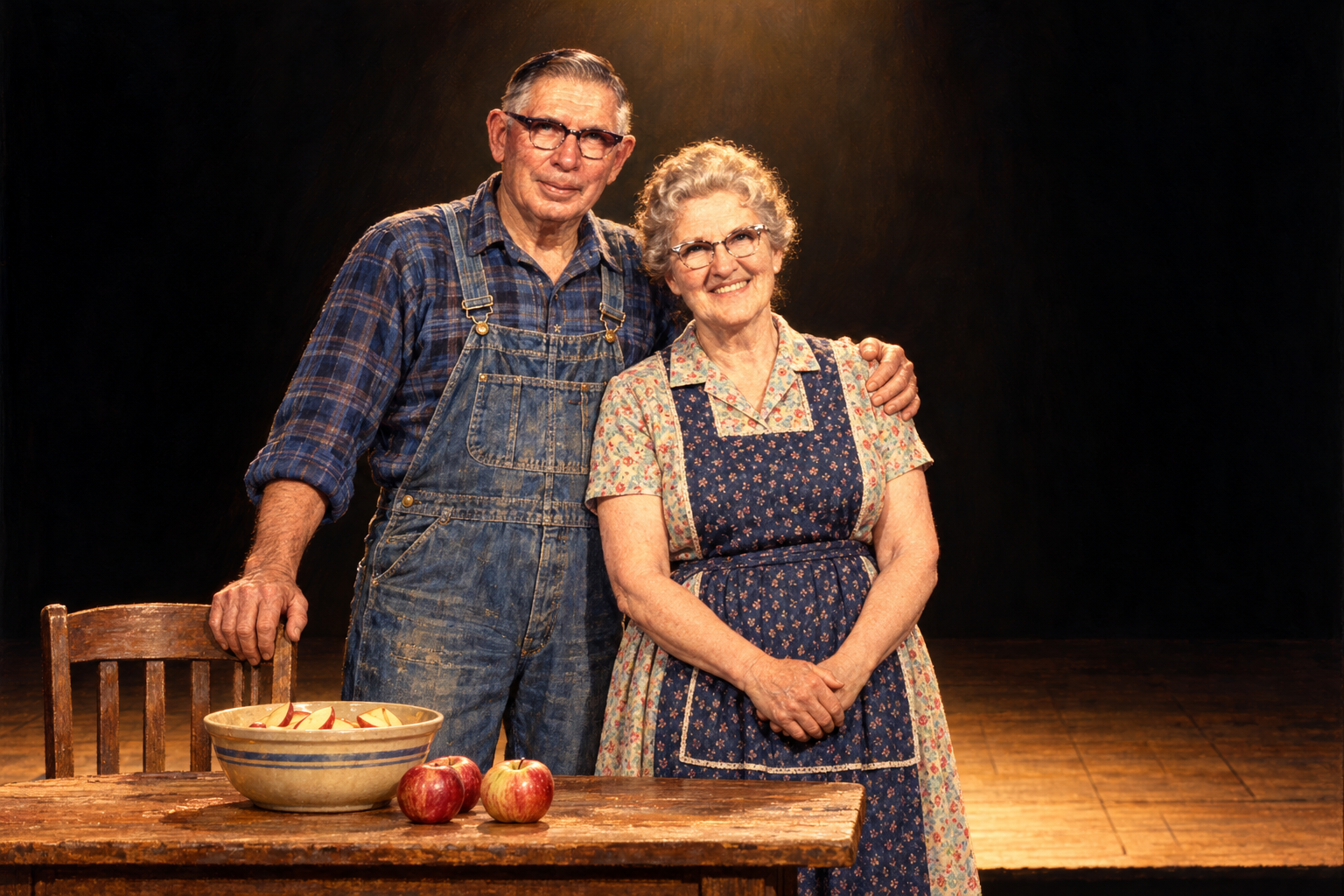
The lights dim, and the stage returns to darkness.