
Most migrations of people through history have been visible and well documented, but an unnoticed migration took place in America’s Midwest during the last half of the 20th century. The owners of small family farms moved to nearby towns as they aged, and their farms were turned over to the next generation of families or sold to a growing number of larger landowners and corporations.
In the fall of 1963 Mom and Dad moved from their farm home of thirty years to Pittsfield, a distance of seven miles. This was after my brother Lawrence and his wife Rachel were married and Lawrence had reached an agreement with Dad about his taking over management and operation of the farm; he was more than just a hired hand, but not yet the owner. Perhaps they tried to make some kind of a partnership work; I was never told the details, but it was clear that as time went by the decision-making and planning became more and more Lawrence’s. By the mid 70’s Dad’s daily trips back out to the farm had ended; he was resigned to full time retirement in town. Dad died in 1978, fifteen years after they moved to Pittsfield; Mom died five months later.
The following is a conversation Mom and Dad might have had, and I admit the dialogue is from my imagination. I know that their favorite time of the day to talk privately was in the early morning hours in the kitchen when we kids were still asleep, before the chaos and demands of the day began. The following exchange in that kitchen begins with a greeting from Mom to Dad:
“Well, I wondered what happened to you John; my land, it’s almost seven o’clock”
“I didn’t sleep so well.” Said Dad, as he entered the kitchen and dropped into the chair beside the stove.
“I’ve got your coffee going,” said Mom. – “Do you remember that Wayland is coming out with his truck this morning to move our bedroom things? I think Wayne may be helping him. You’ll probably sleep better tonight.” Mom moved to the sink and picked up Dad’s cup and dried it with a towel.
“I need to change the oil in the Farmall tractor before Lawrence mounts the corn picker. After that it’s always real hard to get at the drain,” Dad replied.
“I know you’ve got a lot to do and I’ve got to clean up this kitchen some. And I know that you know that we have to move today. Rose Anne had already taken enough of her things in that she stayed at the house in town by herself last night. It’s going to be easier for her, working in at the cheese factory.”
“The hogs need to be managed better,” Dad muttered. “They broke into the north cornfield by the Harvestore yesterday. We might as well leave them there as long as they don’t get out on the road. That’s the first field we’ll have to pick now.”
“John, did you hear me say about moving today? We don’t have a choice so don’t come back in here this evening. Are you ready for some bacon and eggs? Go on over to the table.”
“I will in a minute. If I’m going to have to drive out and back from town every day will I have to eat lunch in the car? I should have built my own room onto the side of the granary or in the barn.”
“Well, we’ve had fifteen good years here in this house,” said Mom. “From New Years 1948 when we moved in until now. And come to think of it, our old original house managed to at least shelter us those first fifteen years. I wonder if we’ll have fifteen years in the house in town?”
“Somehow we managed to raise six kids in that old house,” said Dad, as he stood up. “But they’re all gone, and I’m not sure how well we did. John Edward is gone, Donnie is gone, Margie and Mary Jo have left and Rose Anne has now officially left. I guess it’s a good thing that at least Lawrence is staying on.”
“Rose Anne hasn’t left and you know it!” answered Mom, as she tugged on the corner of her apron. And you know that they didn’t just abandon anything; they had to go on with their lives… and so does Rose Anne. And we had seven kids here; I’ll always include Charles Bernard, even if he only lived 7 months. So the number is seven, not six.”
“Why do you want to bring that up? I’m not trying to reconstruct every detail.” Said Dad, as he brought his coffee to the table and slid into his chair.
“I know; I was just thinking about Charles Bernard last night when I came across some things of his that I kept in a dresser drawer that I was cleaning out. I still have a pair of his shoes.” Said Mom.
Dad looked out the window. “When the sun shines in here from between the barn and the coal house this time of year this is the best place in this house. There won’t be a place for my chair by the stove in the kitchen in town.”
“We’ll make do,” said Mom. “You can sit at the table in there, and we can talk just as well as here and you won’t always be right in my way.”
“Now you tell me that after all these years. I had to sit over at the kitchen table in that first old shack, so I guess we’re going back to that,” said Dad.
“Well, one big difference is that we won’t ever again have to live without electricity and running water like we did then. Nothing will compare to living in that pitiful old house.”
“We had some good times there.” answered Dad.
“I know that. And we’ve had more than our share of good times and blessings in this house too. Remember all the bible club suppers and making ice cream for picnics and get-togethers, and our soup dinners around Christmas and New Years, and just eating our suppers together as a family around this table.”
“I wonder if we’ll ever all be together again, with Margie and Mary Jo gone.”
“They’re not gone; good heavens, you make it sound like they’ve disappeared forever. We’ll be going up to see Margaret in November, remember.”
“There’s a lot of corn to be picked and hogs to sell before then. And we’ve got to find some more boars for the spring crop of pigs. The next big bunch of pigs will start coming right at Christmas, and there’s a lot to get ready before that.”
“What’s different about that?” said Mom. “You will be doing a lot of driving every day, but when winter comes we’ll be glad we’re in town. Think of that first big storm when we’ll be able to get out on Sunday morning and drive over to church without worrying about the roads?”
“After I scrape all the windows. We won’t have a place to park the car out of the weather.”
“Why don’t you have Wayland build a car port on the south side of the house,” asked Mom. “He’d be happy for the work, and would do a good job.”
“I don’t want to block what little sunshine can make it in that side of the house. Do you have my things packed? What about my recliner? Are we going to have someone bring in stuff from the front room?”
“We may not get everything today, but we will in time,” said Mom. “And Lawrence will see that we get what we want. Rachel needs to get out here and have this place to herself as soon as possible. It’s been inconvenient for her, starting to teach school and not really moved in here yet. Here’s the toast; your eggs are done and the bacon is just the way you like it.”
“I guess I’ll miss this time of day right here, and all the surroundings that we’ve lived in for the last thirty years. Are you bringing your sewing machine?”
“Yes, our bedroom won’t look a bit different in town. The rest of the rooms will be just a little smaller.”
“I’ll miss the basement. Where will I change when I come in from the hog sheds or off the tractor?”
“We’ll work it out; just so you come home safely. I hope your driving morning and night isn’t too much.”
“I’ll be home. That’s another thing; I won’t be able to see you during the day like I always have.”
“Oh; John, don’t make me start crying; I was doing so good.”
“I guess that’s going to make the house in town all right; knowing I’ll be coming back to you.”
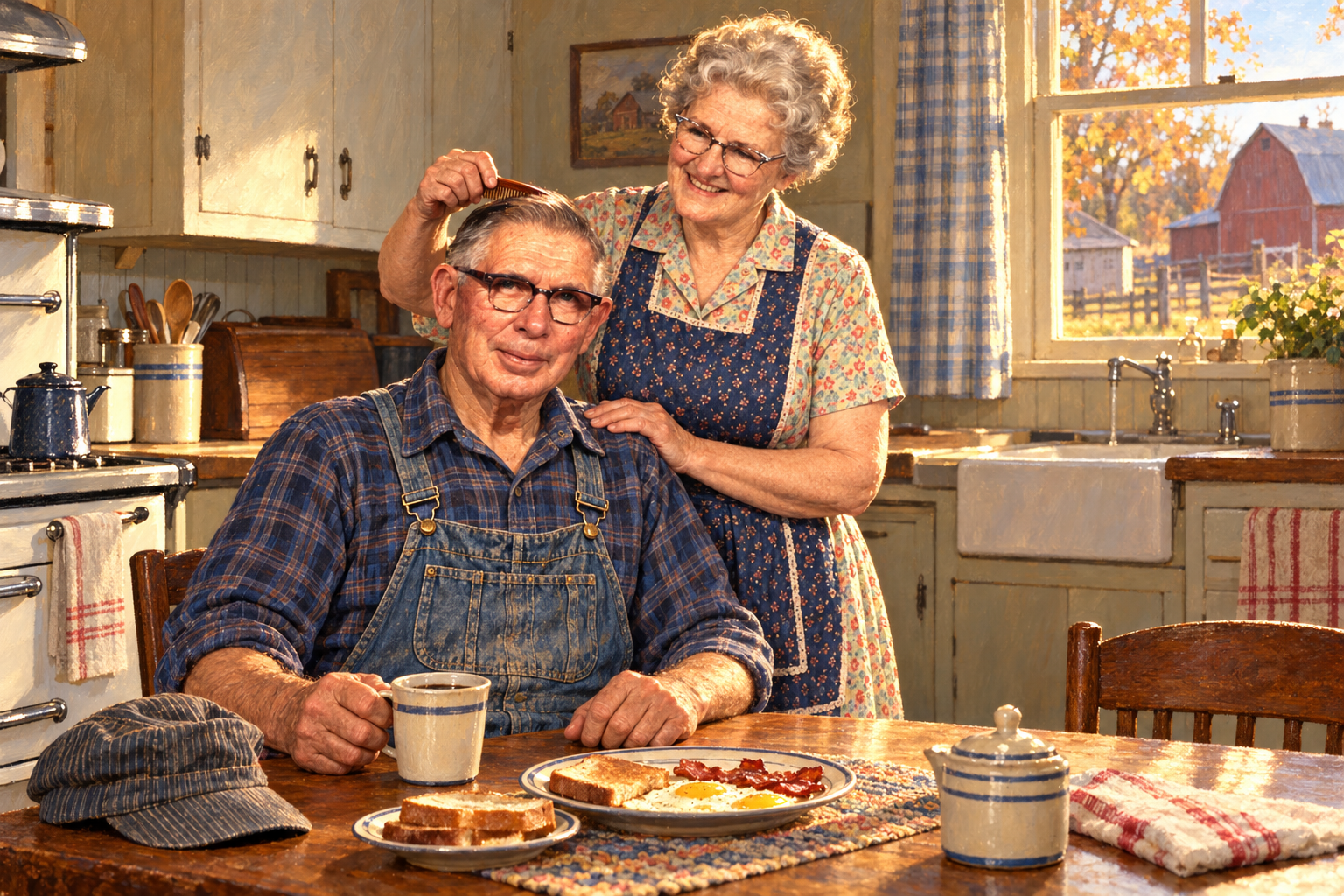
“Sit still just a minute more so I can part your hair with this comb; you never get it right.”
“I’m just going to put on my cap anyway, but I like that. As soon as you’re satisfied with my hair, let’s eat. My coffee’s getting cold.”
“OK, now you look dashing. As Fr. Scanlon used to say, ‘this is the day the Lord has made; let us rejoice and be glad‘.”
By the mid 70’s Dad’s daily trips back out to the farm had ended; he was resigned to full time retirement in town. Dad died in 1978, fifteen years after they moved to town.