I’m sitting on my patio in the afternoon sun of an early spring day. The March wind rings an old Japanese bell that has hung under the eve at the corner of our family room for the last seventeen years - since I hung it there in the summer of ’92 when we first made this our home. From the moment I found it at a flea market in Shinagawa in Southwest Tokyo one Sunday afternoon when we lived there, I knew it would someday be my companion on my patio, and so it is. It’s quiet when the wind is too soft and also when the wind is too strong… the wind has to be just right.
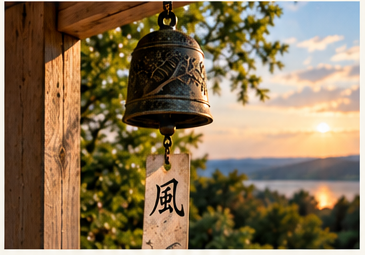
The bell’s tone blends with the sounds of kids playing, softened by their distance; they must be on spring break. Today is March 17, St. Patrick’s Day. After watching the parade, I returned here to keep it low-key; we’ve celebrated St. Patrick’s Day two Saturday nights in a row already. But we may go over to Donnelly’s Pub later.
A dog barks in the distance, and I hear the call of a dove that doesn’t seem to come from any particular direction; something I find appealing about the dove’s softly shy call. A woodpecker makes his presence known, and the bell responds, and so goes the afternoon. A basic requirement associated with successful aging is to sharpen the sense of hearing; at least until the hearing goes too. I sit and listen. Not a bad pastime. A door behind the hedge slams - that dove calls again - and above it all the March wind pushes aside the treetops as it hurries somewhere to the east. I try to think about nature out here, but I’m almost too immersed in it. I feel like one of the young fish in the story of an old fish swimming past a pair of young fish that asked, “How’s the water?” They answered, “What’s water?”
There is a best time for certain events of nature. A big egg-yolk moon on the horizon belongs to a hot summer night. There is a special blue to the northeast sky a couple of hours after sunrise in late September - so special that you really should mark a date on your calendar to watch for it. The best sunrises in the summer start so early that you almost have to sleep outside so the songbirds will wake you in time for you to watch from under a dew-dampened blanket as a scarlet sky begins. Stars were best when I was young; one Christmas Eve the night was so cold and the sky so clear that riding home in a wagon in the dark from finishing chores, the stars seemed to come down so close I could almost reach out and hold a handful to keep them warm. And there are certain sounds like frogs croaking on a pond behind the barn that only spring supplies… but the wind claims all the seasons.
My mother didn’t like the wind, especially in the winter. “John, would you throw some water on the north side tonight?” she would ask my dad before he had removed his coat and boots when he came in for the night. The little house we lived in seemed to tremble in the winter. Wind gusts could raise the front room rug, where the cracks in the floor were widest. Dad would stack bales of hay against the foundation on the north side of the house and that helped. But cold found its way in around the windows and past the siding and plaster that comprised the outside walls, so small bits of winter crept in to keep the old Warm Morning stove in the front room working until it turned orange around the bottom. A bucket of water thrown against the house froze before it ran off, effectively closing the pathways for the cold, which made the front room tolerable. We would have won the battle against the cold for another night, and Mom would find something to read to us at bedtime.
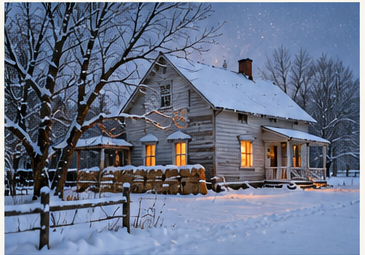
Summer storm winds could sometimes take us by surprise. There was no weather channel, no sirens, no police scanner - we developed an instinct. When it got too hot, when the leaves on the trees seemed to turn over, when it got too still, watch out! As the first dark edge of a storm came over the horizon, we paid close attention to how fast it grew. The first flicker of lightning was another sign of an approaching storm. It was time to stop mowing or cultivating or hoeing or picking blackberries or whatever and head toward home. Even then many a summer storm with a furious wind out in front leading the rain and lightning and thunder would descend on us before we made it inside. The worst storms seemed to last forever, and the big maple tree would bend and groan toward the house. “What if the storm tears our tree out of the ground and it lands on our house?” we would cry. Dad would say, “Don’t worry; the house will be gone before the tree goes.” That provided little consolation. But we survived those moments we shared being scared and realized how powerful nature was as we experienced it too close for comfort.
My Uncle Loren and Aunt Mary were my dad’s brother and sister. Neither ever married. They lived about a mile away, in the family home where my dad had grown up. Their house was a two-story, featuring a living room with lace curtains and screens on the windows. When I was small, we would from time to time find ourselves at Aunt Mary’s for an afternoon; it was the closest my mom got to some time for herself, I suppose. At any rate, the screens could detect the faintest of breezes on a summer afternoon when Aunt Mary would try to get my brother and me to “rest” for a while. The curtains would hardly move, but there would always be a soft whisper from the screens.
Two sources of “wind detection” included barns and willow trees. Any rainy summer afternoon when the opportunity to do nothing arose, our barn’s hayloft was a great place to sit and look out the window toward the woods. The wind made an assortment of sounds through the cracks in the barn siding and under the eves and past the loose shingles overhead. The wind and rain blended into a perfect recipe for daydreaming.
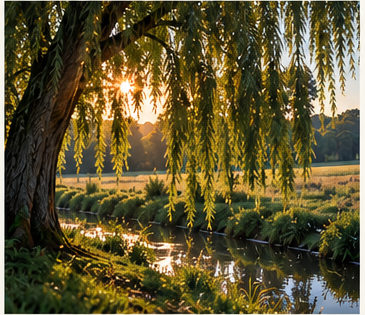
For serious cloud watching and solitude on any summer or fall day, nothing could beat sitting under the big willow tree over in the north pasture by the stream that flowed from the spring in the woods. The willow tree was a wind sound amplifier; it could detect the slightest movement of the air. I loved the graceful swaying of the branches; graceful even when the wind was strong.
I agreed with my mom that I did not like the sound of the wind through pine trees. The cemetery sound that came from the pines at my Aunt Ollie’s was relentlessly the same. No change in tone or melody - just a steady low whispery moan that I did not like. On the other hand, I have a lovely tall pine at my front door that I would never want to part with. My compromise is a small wind chime that hangs on a lower bough to blend some music into the sound of the wind.
It’s Monday morning all of a sudden, and the Japanese bell warns me that rain is coming. The wind is blowing through the hedge and urging the buds on the lilac bush to come out and play. This might be a good day for kite flying before the rain gets here, so I must leave my study. Perhaps I’ll go down to the woods behind the Nature Center this morning.