Ms Edith
Aberdeen School was a one-room country school one mile northwest from our home; I walked to and from it my first five grades. The smells of chalk dust, the red oily sweeping compound used on the floor each morning, musty books in the small library cabinet, damp coats in the cloak room, the coal bucket, a pan of beans cooking on the stove to give us something warm with our sandwiches in the wintertime are still with me. When Aberdeen School closed in 1946 we attended a larger one-room school called Cold Water, about three miles away on the El Dara road. For one year Connie Lewis, with his daughter Linda Belle, transported us in his car. We were bussed to Pittsfield when I was in 7th and 8th grade Junior High, and in the following years to Pittsfield High School.
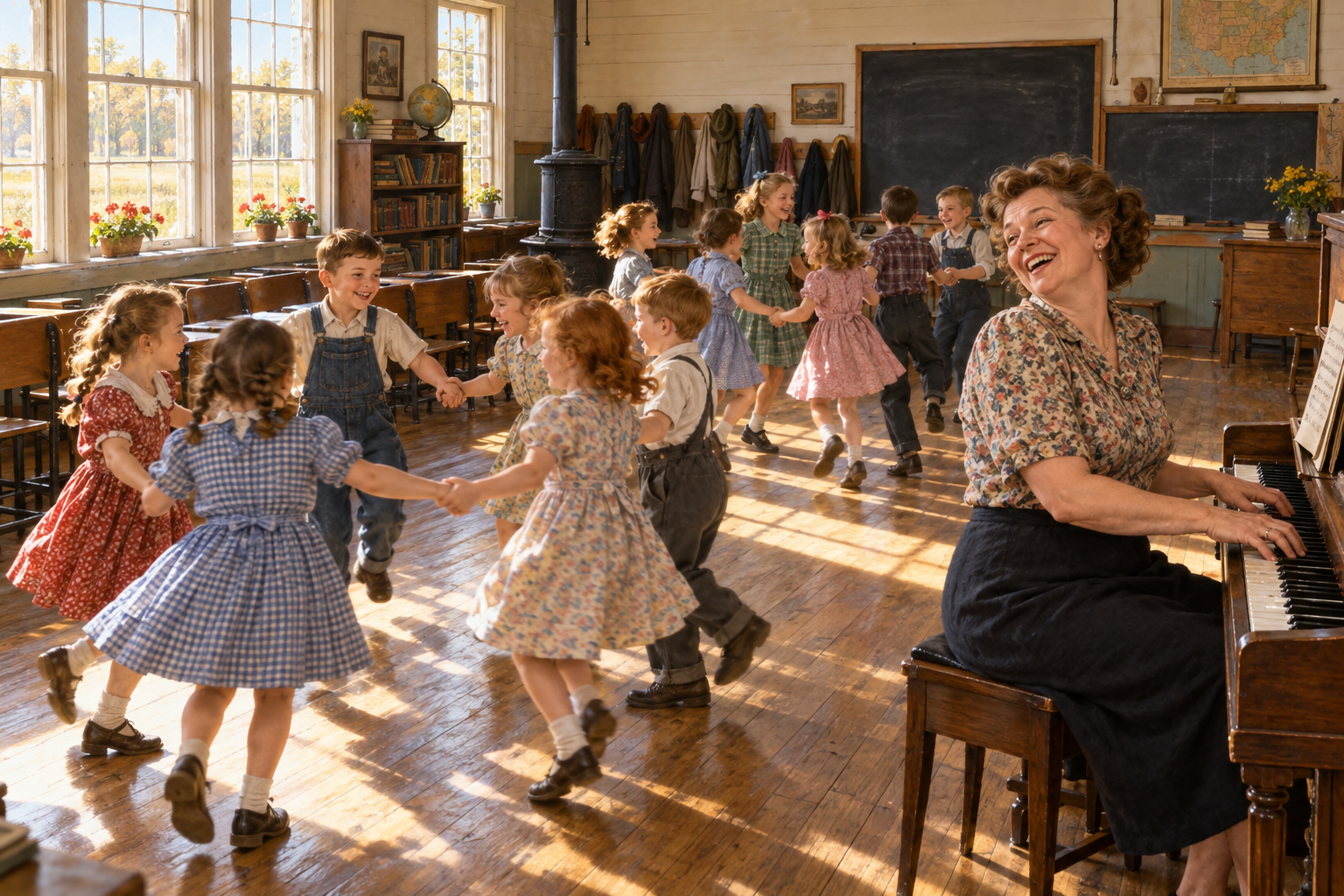
“Ms Edith” Kelly, as we called her, was my teacher for 1st and 2nd grades. There were two other kids in my class: Linda Belle Lewis and Dale Harshman. Not all grades were represented, as there were only twelve or thirteen kids in the school in 1942. Ms Edith would always begin the day with piano music. “All right, everyone, let’s dance!” She would have us form two circles, pushing the desks out of the way so we had room to move freely. Her piano playing included songs like “Pistol-packing Mama” and “She’ll be coming Around the Mountain when she comes”, and she could really pound them out. It’s a wonder that the old upright Baldwin piano held together! All her fingers were heavily adorned with rings, which I expected to fly off as she played with such total abandon and energy. The little schoolhouse literally bounced as we stomped around in two “dotsie-do” circles while she played and sang as loudly as she could. She would often end with other songs including “There’s a Star Spangled Banner Waving Somewhere” and “God Bless America”.
Ms Edith supplemented the pictures on the walls - Washington, Lincoln, and FDR - with four others: Generals Eisenhower and MacArthur and her two sons serving in the Pacific. From time to time she would read some excerpts from their letters, and she never knew exactly where they were; that specific information was edited out. Sometimes she would cry just a little. She would call the grades to the front of the room to chairs adjacent to her desk for recitation one grade at a time, We would go through our subjects; reading, math, spelling, history, and geography, receive our assignments for the next day, and then return to our individual desks.
As the day progressed, we were expected to work on our assignments for the next day, as subsequent classes recited. Sometimes, depending on the head count, two classes might combine. During breaks between recitations there were chances to ask questions about the assignments. By late afternoon (dismissal was at 4:00 pm), we younger kids would sit and listen to the older kids’ history and literature recitations, which were fascinating to me.
Ms Edith would set aside time on Friday afternoons to celebrate the week. She would bring a generous supply of Baby Ruth and Butterfinger candy bars, and she always found something that each kid had accomplished that week to merit the award of a candy bar!
Across the road from the schoolyard lay Bennie Whitmeyer’s woods. It was filled with wild flowers in the spring and beautiful foliage in the fall. Sometimes - not on a fixed schedule, but when some particularly beautiful spring morning or fall afternoon beckoned Ms Edith - we would take an extended recess and hike through the woods.
She was totally dedicated to her work as a teacher. That was what she did. No identity crisis for her; she was too busy living life and doing. She was a great person for any kid to have as their first grade teacher. I could tell she had affection for and interest in me, and that was a good feeling; I suppose today that would be called affirming.
Georgia
I entered the University of Illinois the fall of 1954 and stayed at a boarding house called the 907 Club, at 907 South 6th Street. The uncreative name of the house was matched by the uncreative food ladled out by Ollie and Mary, the owners and cooks (owner and cook is a bad combination, if you expect much in meals). Thankfully, they changed it to rooming only the next year - no more food. Since the location was great, I returned. But after one semester the fall of my sophomore year, foraging for meals at local greasy spoons, I went looking for a “meal job” that spring.
I am sorry that I can’t say Georgia’s last name, but I don’t think I ever knew it. She was the cook at Delta Delta Delta sorority, uncreatively called the Tri-Delts, where I got a meal job that I had for the next 2 ½ years. The Tri-Delts housed about eighty-five girls, right behind the 907 Club. More properly, the 907 Club was behind the Tri-Delts - The 907 Club back door was about forty strides from the Tri-Delts back door. However, in terms of “front door social standings”, the 907 Club front door was an immeasurable distance down from the Tri-Delts front door.
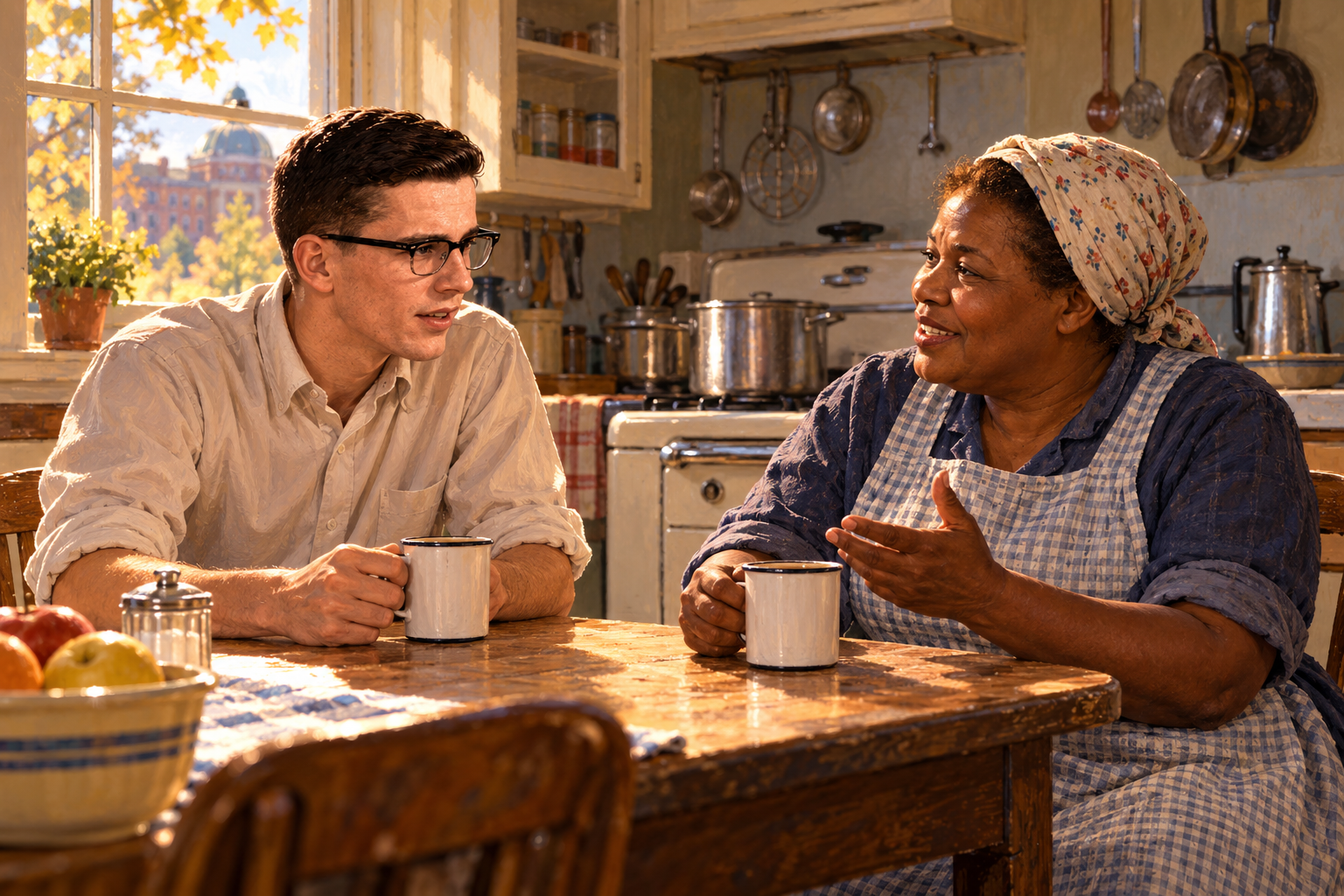
As for my first impressions, I saw Georgia as a caricature of Aunt Jemima or Hattie McDaniel of actor fame. Politically correct terms like African American and Black had not evolved in 1956; accepted terminology was still Negro or Colored. Georgia was short and overweight, wore a bandana wrapped around her head, and had an apron across her front that almost reached the floor. She moved with a pronounced limp that she claimed was the result of a car accident. She stuttered when she got flustered, hurried, or was talking to Mrs. Gilchhrest, the House Mother. I soon discovered that she was the most wonderful cook that I’ve ever known! She ran the kitchen like Leonard Bernstein conducting an orchestra. She was in her element when three or four major things were cooking simultaneously and had to come together with no time to spare. She could give orders with the best boot camp sergeant, when need be, but would regress to a diffident, “yes ma’am” style of dialogue with Mrs. Gilchrest that frustrated me.
In time, on early mornings over coffee with her before the chaos of the day began, we developed a real friendship. She had been raised in Cairo, Illinois, which had a Jim Crow atmosphere well into the 1950’s. She took pride in having survived the environment of her youth - moving on to Champaign and earning the status and recognition of an exceptional cook - not so much with the Tri-Delt girls, but more importantly with her friends and neighbors.
Georgia was aware of the goings-on of the girls, which at times probably met or exceeded the most salacious and perverted imaginations of even the “pots and pans” guys. We laughed privately about the new waiter who only lasted through one Sunday “dress-up” dinner. He let some fresh hot peas roll off the plate as he tilted it too much while placing it in front of Roxy, the subject of the most lewd of our imaginations. The hot peas went plummeting down into her generous cleavage! We laughed about the flat-chested girl who came down to breakfast one morning with her sweater on backwards. Her sorority pin was on her back, dangling off her right shoulder blade, instead of around on the front of her left breast where it was supposed to be.
Georgia drove a big long black Cadillac sedan. It sat very low probably because the springs were broken. One Sunday morning in May, she suddenly discovered that she had forgotten to bring some leaf lettuce out of her garden that she wanted to use. So she tossed her car keys to me. “Don, run back to my house and pick some lettuce in the garden beside my house; just break off enough to fill this sack and hurry!” She gave me her address, just east of Neil St. and north of University Ave., in the middle of the Negro neighborhood.
I felt many eyes on me from the families walking to church that morning, when they saw Georgia’s car come racing down the street with this skinny white kid peeking over the steering wheel. This was too preposterous an event to be anything but legitimate, so they just shook their heads, smiled, and kept on walking. I parked in her drive, and her husband came out onto the porch. I explained my mission; he pointed me toward her garden and disappeared back inside. I finished in a flash and was out of there. Georgia could sense my discomfort -- she had gotten me out of my comfort zone about as well as anyone ever did, but she was most appreciative.
When I met my wife-to-be Jan, I had stopped working at Tri-Delts, but I took Jan back there. We went to the back door, not the front door. I wanted Jan to meet Georgia, since I had already used the compliment “Wow! That tastes as good as Georgia’s!” So Jan got a chance to know who I was referring to. That was almost fifty years ago, but I still remember the sounds and smells and chaos of Georgia’s kitchen.
Mrs. Rabinowitch
This lady was a housewife, also in Champaign, Illinois. In the fall of 1955 I placed my name on a list of students looking for part-time work posted at the Student Union Building. People in the community seeking someone for part-time work called, and someone on the Student Union staff paired up a student with an employee. So I soon received a call. “Don, do you want to go Saturday morning and take down screens and put up storm windows? It’s for a Mrs. Rabinowitch, out in northwest Champaign on Church Street,” the caller explained. “Sure,” I said, without checking the distance. “I can do that.” Saturday morning I started riding my bike down Green to Prospect to Church and realized it was three plus miles on busy streets! Once I turned off Prospect onto Church St., it was a lot quieter, though, especially on a Saturday morning.
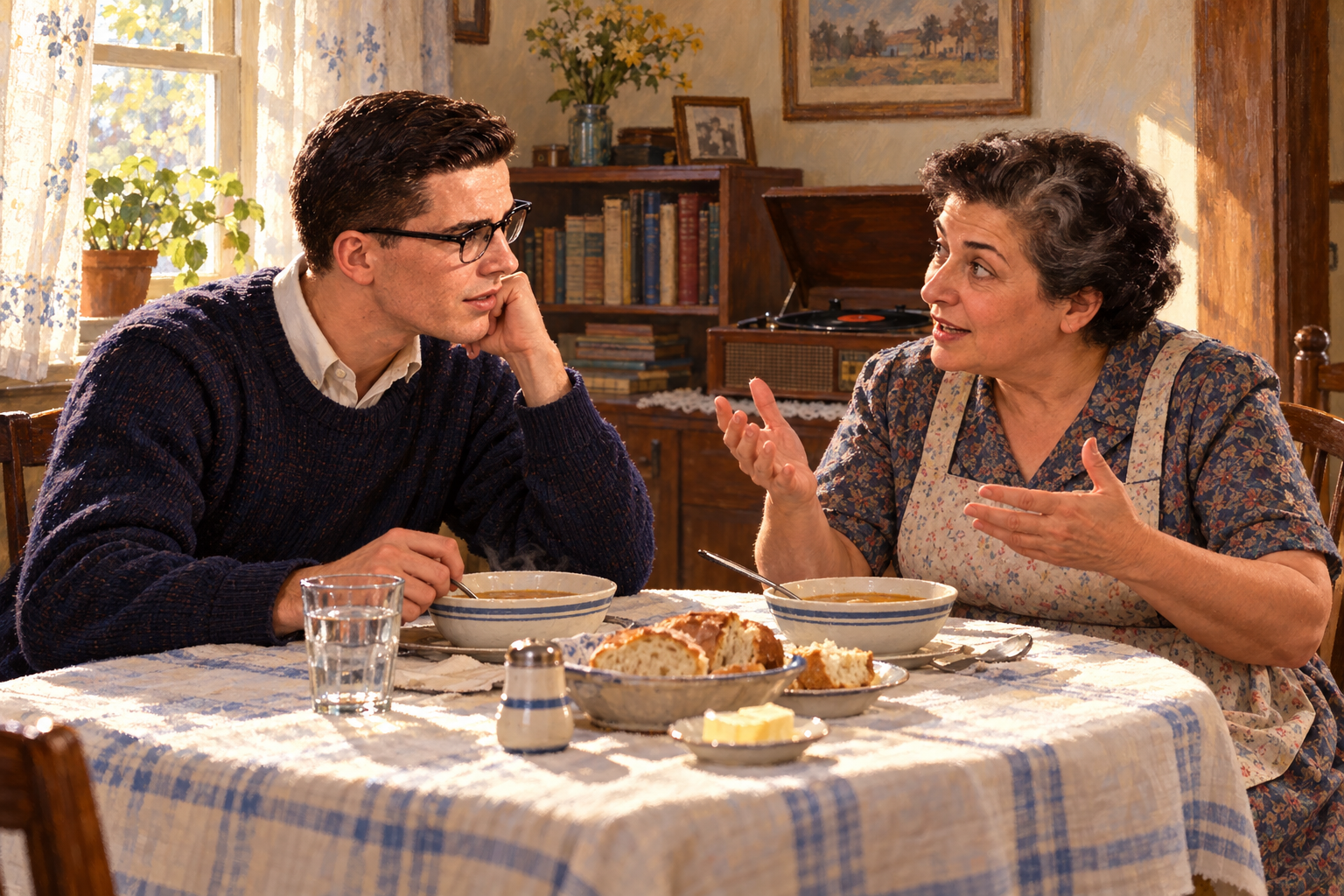
Mrs. Rabinowitch was middle-aged, with dark hair that was starting to gray and short in stature. She had a plain face but a flash in her eyes and a very direct, “in-your-face” way of examining a person that made me nervous at first. I felt like she was really looking me over, trying to decide if she wanted to bother giving me all the necessary instructions about where the storm windows were, her standards for cleaning, and where to store the screens. She spoke with an unfamiliar accent and kept a close watch on me as I worked. Not much else was said that first meeting, except she did give me $4.00 for the four hours I spent, and another $1.00 for “the trip,” as she put it; she appreciated how far I had to bike. More importantly, she asked me if I wanted to return the next Saturday to help her clean the basement. I gave a silent sigh of relief; that meant I had passed her “inspection”, and I might not have to work through the Student Union staff for different jobs. There was something about her little cottage on Church St. that beckoned me to return, despite the length of the trip.
That next Saturday she started asking me questions: where was I from, what kind of a farm did I live on, what did I like to read, what kind of music did I listen to, did I go to movies, and questions about current affairs that I was hardly aware of. She was just naturally curious; no one had ever shown such an interest in me, and I was just some part-time help. If she was disappointed about my shallow parochial worldview, she disguised it well. I cleaned the basement and swept and scrubbed the dining room and living room. It was a small house with a single room upstairs where her husband had his office.
In time I began to understand and appreciate her interest and enthusiasm about such a multitude of things. She had emigrated from Europe in the early 1940’s. Her life story became very fascinating, told over lunches that she started fixing for me, stories that unfolded over the rest of that winter and spring. She was born into a Russian Jewish family that had been part of the highest society in Moscow before the revolution. She told me bits and pieces of intriguing stories about the beautiful women in their fine furs, carriages with footmen, the ballrooms and celebrations that she observed as a girl. Then came the 1917 revolution. Her family escaped to Eastern Europe and into Poland and eventually to Germany. She became part of a traveling ballet company and moved to England toward the late 1930’s when she knew it was dangerous for Jews in Germany; she had no ties to keep her there. She met and married Eugene Rabinowitch in England, and they moved to America in 1942.
Whenever I went to their home, I was transported into another culture. When her husband was home they conversed in Russian, the first time I experienced that humbling condition of not understanding anything being said. He acknowledged my presence in a courteous but disinterested way. She cooked with ingredients unknown to me: strange cheeses and sauces, wines and mushrooms, exotic soups and seasonings. Her cooking produced smells that were foreign to my senses. She cooked lamb and made dark gravies and wonderful pastries. One time she had me help her prepare and package an entire spread of food that we transported in her old Ford sedan to her friend’s daughter’s wedding rehearsal dinner.
If you were to “Google” Eugene Rabinowitch you would be amazed. Dr. Rabinowitch was part of the team of scientists that developed the atomic bomb. He was on the Manhattan Project at the University of Chicago. He was the leading authority on photosynthesis, having written a three-volume text on the subject, and he was the co-founder and editor of a magazine called The Bulletin of Atomic Scientists. I learned that about him back in the pre-internet days from observations and comments by others who found out that I had developed a friendship with the Rabinowitches.
I must have hinted at their modest home and belongings; Mrs. Rabinowitch responded, “I will never have any possessions that I cannot accept losing.” She did have a nice stereo phonograph player on which she played opera and classical music. I can’t say that it really became my music of choice, but that’s how I obtained at least some exposure to Beethoven, Rachmaninoff, Rimsky-Korsakov, and Mozart, certainly more than any of my engineering student buddies had. They did have one other extravagant possession: a summer home in southern Vermont. I had never heard of anyone having a summer home! She spent the summers there, and that is how I came to spend the summers of 1958 and 1959 at their house - free lodging while I worked at the Agricultural Engineering Department and took some classes. By then I had a little beat-up 1952 Ford for daily transportation, so it was a great setup. I kept the lawn mowed and things cleaned up from Dr. Rabinowitch’s occasional comings and goings. I “kept the lights on”, which she appreciated.
Besides Georgia, she was the only other adult in Champaign, whom I wanted Jan to meet that fall of 1959, soon after we started dating. Mrs. Rabinowitch and Jan charmed each other; she approved, but opined to me later in private that neither of us knew anything about life yet. We realized later that she was right. Later that winter I had saved a little money from my Graduate Assistantship job at the Agricultural Engineering Department, and when I contemplated the purchase of an engagement ring for Jan, I revealed my intentions to Mrs. Rabinowitch. She unhesitatingly told me what jeweler in Champaign to go to and to tell him that she had sent me. I went through the purchase process alone; I knew just what Jan would like, and I was right. But the ring that the jeweler delivered to me several weeks later was even more beautiful and larger that I had remembered from my initial visit and order. I never worked up the courage to suggest to Mrs. Rabinowitch that she might have influenced him, but I’ve always suspected that she did find a way for the jeweler to give me more of a ring than my meager payment covered.
I still treasure two things from Mrs. Rabinowitch: the book War and Peace that she gave me one Christmas (yes, I read it from cover to cover) and a large wooden salad bowl that she gave us for a wedding present.
The last time I talked to her she was in the spring before I moved to Peoria (and before she left Champaign for Vermont for the summer). She was very concerned about a trip she had been invited to take with her husband. She had to decide if she would accept the invitation to return to Moscow, USSR. She would be accompanying him to a conference where Dr. Rabinowitch was scheduled to speak. She had never imagined going back to her homeland, and the prospect filled her with trepidation. I’m sure she got our address from a thank-you card Jan sent her for the large salad bowl wedding present. Anyway, the evidence that she returned to Moscow came in the form of a postcard.
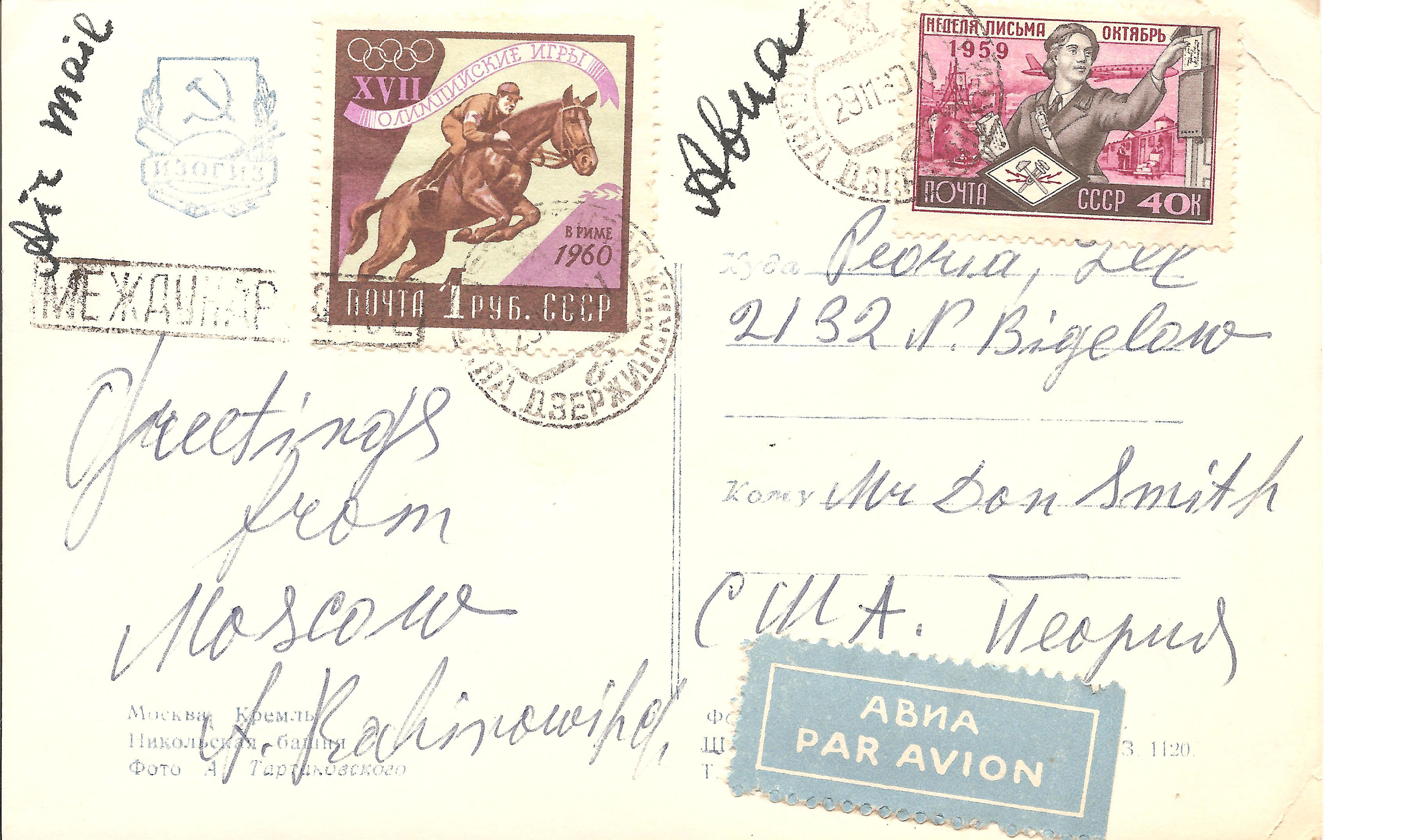
A post card from Mrs. Rabinowitch – mailed from Moscow in 1960
~~~~~~~~~~~~~~~~~~~~~~~~
Why do I remember these three women? They floated into and out of my life many years ago. I have no pictures of them except in my memory. They couldn’t have represented more diverse backgrounds or personalities. Yet they all had a common set of traits: they knew who they were - they got their jobs done, not waiting for someone else to act; they carried themselves with dignity.
There is an old saying that the seed never sees the blossom, and that was true for them. The “seed” they each planted in their own way on my behalf was that they cared about me, they were interested in me, and they affirmed me. They were very authentic, very real women, and I’m much richer for having known them.